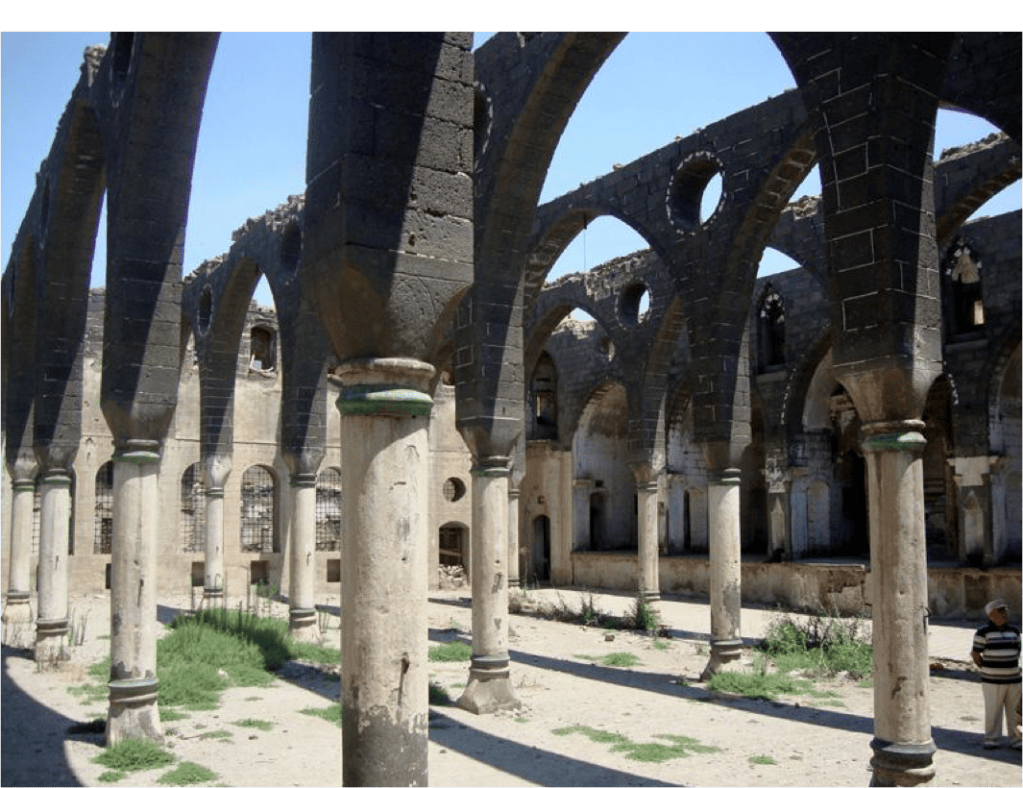
Inside Surp Giragos Church before restoration.
Archive date: 10 March 2015. Revised in October 2026 to include the later damage and the 2022 reopening.
When Surp Giragos Church reopened in 2011, its restoration offered a striking encounter with Armenian history in Diyarbakır. The repaired building made a place of worship accessible again in a city whose Armenian population and institutions had been devastated by the genocide of 1915 and the disruptions that followed.
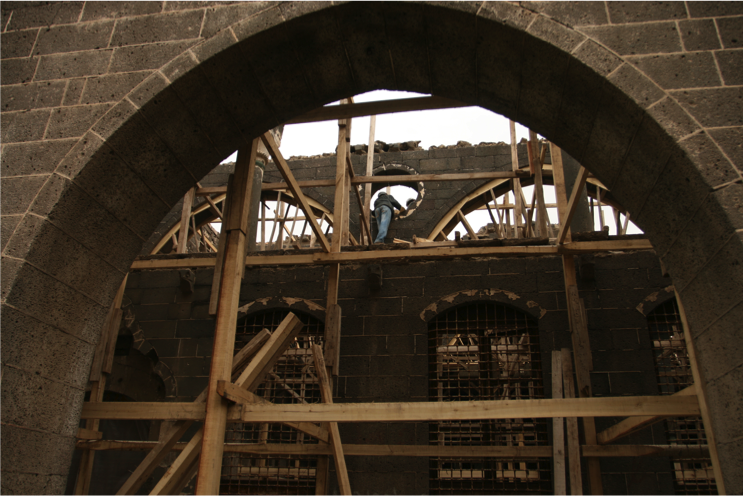
The church stood at the heart of an Armenian neighbourhood within Diyarbakır’s old city. Its black basalt walls, interrupted by lighter stone, connected it to the surrounding urban architecture. Years of disuse had damaged the building, and its roof had collapsed. The restoration, undertaken through Armenian community initiatives with support from the Kurdish municipality, gave these remains a renewed public presence.
A song by Stepan Ilhan captured something of that encounter. Addressing the church as if it were a person returning to life, he imagined its difficulty in recognising the visitors now entering its courtyard. They were the grandchildren of people it had once known. Welcoming the church back also became a way of asking whether the church could welcome them.
In my earlier notes, I was interested in what this restoration made possible for descendants of Armenians whose family histories had been concealed or displaced. The building supplied a place in which those histories could be discussed and explored. Visits, language learning and religious practices could give a public form to memories that had previously remained within families.
These experiences were not uniform. Armenian ancestry did not imply a single relationship to religion, language or belonging, and the restoration did not bring an entire lost community back into being. It made new encounters possible while leaving the differences between people’s histories and choices intact.
The church therefore raised a question that runs through my research: what can the restoration of a monument repair? Reopening a building can change the conditions in which people meet and remember. It cannot by itself reverse the violence through which a community was destroyed or resolve the disputes surrounding its inheritance.
The later history of Surp Giragos makes the limits of the original restoration especially clear. The church was heavily damaged during the conflict in Sur in 2015. Another restoration followed, and it reopened in 2022. The hopeful account written after the first reopening needs to be read alongside these subsequent disruptions.
Surp Giragos remains a place through which Armenian memory can be encountered in Diyarbakır. Its successive restorations also show how vulnerable that possibility is to changes beyond the church walls. The relationship between a repaired building and the lives that gather around it remains unfinished.


You must be logged in to post a comment.