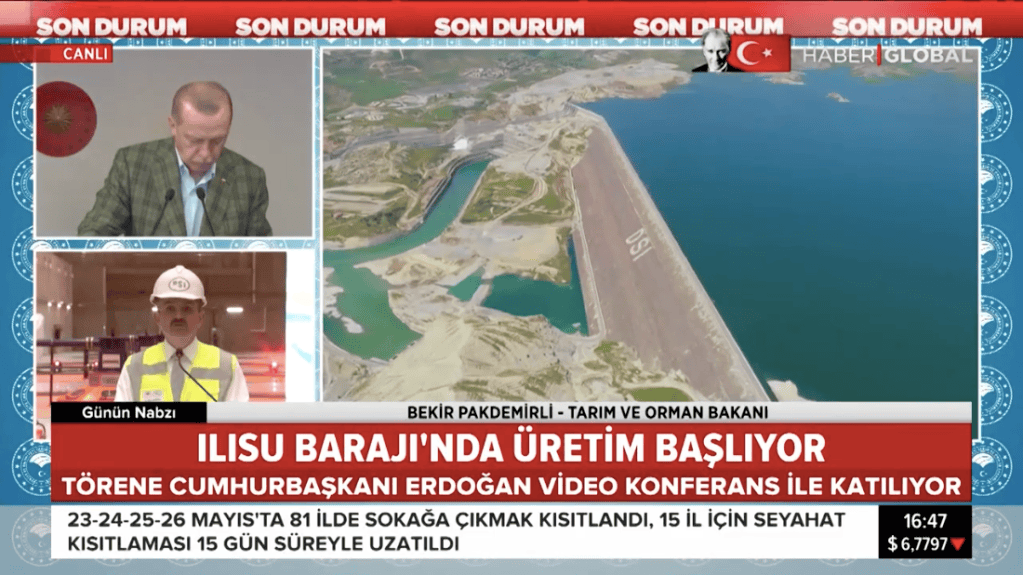
The Ilısu Dam and Hydroelectric Power Plant was officially inaugurated by Turkish President Recep Tayyip Erdoğan on May 19, 2020. Turkey’s fourth-largest dam is part of the Southeast Anatolia Project (Güneydoğu Anadolu Projesi or GAP), a development project implemented in 1984 to improve the economic and social conditions of the country’s impoverished, mostly Kurdish, southeastern provinces. The event was aired live on most government-controlled news channels, including TRT HABER, as well as on President Erdoğan’s Facebook page. Not present inside the power plant amidst the COVID-19 outbreak, Erdoğan delivered the inaugural speech from his office in Ankara by video-conference with a small Turkish flag pinned on his pickle green, plaid suit and the official seal of the Presidency (a sixteen-pointed sun surrounded by sixteen five-pointed stars standing for the sixteen Great Turkic Empires as mythologized in pan-Turkist ideology) behind him. The ceremony provided Erdoğan with an occasion to rewrite the past by placing his Justice and Development Party’s reign (the Adalet ve Kalkınma Partisi or AKP) in power since 2002 at the pinnacle of Turkish history. During the AKP’s eighteen-year rule thus far, Erdoğan reminds his audience, Turkey has gone from 276 to 861 dams, from ninety-seven to 778 power plants, from 202 to 587 irrigation ponds, and from eighty-four to 331 drinking water facilities and other facts. He announces during the same speech the future construction of one dam per month for a total of seventeen in the next year or so. “In energy and water, do you know what this means?” Erdoğan concludes, “Turkey can be counted as one of the top revolutionary countries in the world in renewable energy.”
During the opening ceremony of the Ilısu Dam, President Erdoğan declared: “[t]he cost of the Ilısu Dam, including the resettlement, the protection of historical and cultural heritage, the construction work and other spendings, reached a total of 18 billion liras. Regarding the dam construction, all of the historical and cultural heritage, especially those of Hasankeyf, has been protected with the utmost care. Just for the works at Hasankeyf, a total of 200 million liras was used.” This is a rare occurrence in the speech where Erdoğan refers to Hasankeyf flooded just a few months prior to the inauguration. Here, however, the medieval town represents just another cost for him. More generally, the protection of cultural heritage is equated to so many million Turkish liras, but how exactly this large sum was used is not detailed. For Hasankeyf, the amount itself (200 million liras) seemed to be proof enough that the town had indeed been saved. The sum is not negligible of course, but it is relatively small compared to the 2,8 billion liras the dam will bring each year. What is more important for Erdoğan, however, is how the money spent on the protection of cultural heritage allows him, in the end, to make the claim, true or false, that indeed Hasankeyf “has been protected with the utmost care.”
This is a part of a longer article“Hasankeyf, the Ilısu Dam, and the Kurdish Movement in Turkey” published in a volume edited by Stephen E. Hunt titled Ecological Solidarity and the Kurdish Freedom Movement.

