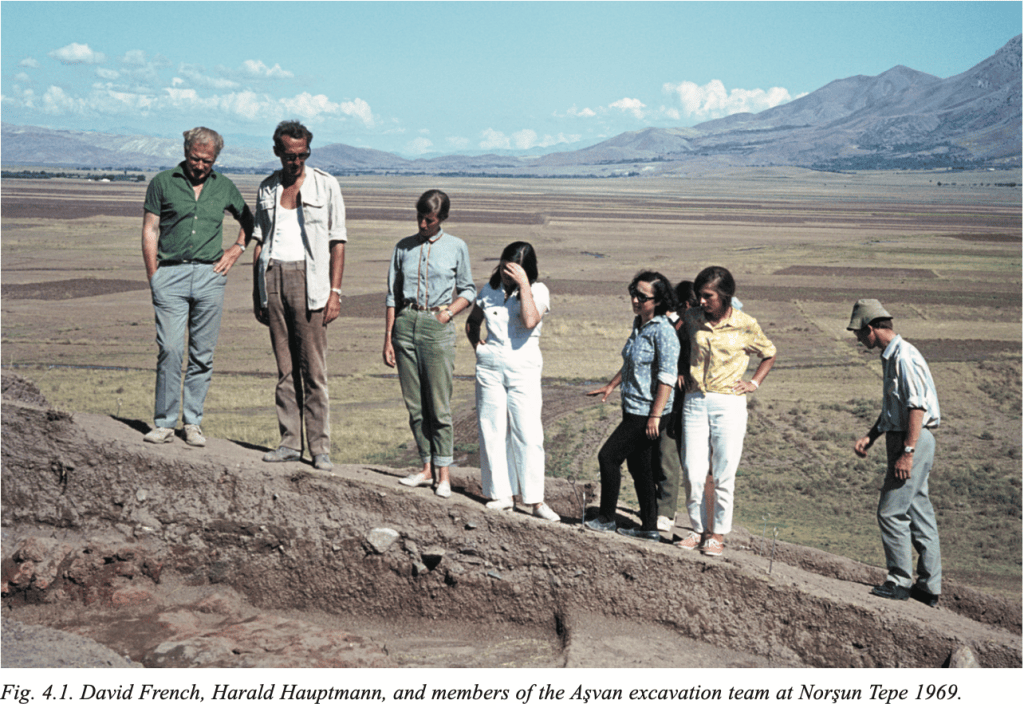
Source: Stephen Mitchell (ed.), David French: A Life in Anatolian Archaeology, British Institute at Ankara, Electronic Monograph 11, 2020, p. 19, fig. 4.1.
How does someone learn to be an archaeologist? Training includes books, lectures and technical instruction, but much of archaeological knowledge develops through working alongside others. Excavators learn how to recognise a feature, handle an object, make a record and judge what deserves attention through participation in a team’s everyday practices.
My article “Learning by Doing: Archaeological Excavations as ‘Communities of Practice’”, published on 18 September 2019 in the Bulletin of the History of Archaeology, examines this collective dimension of fieldwork. It shifts attention towards the group: the relationships through which methods are shared, questions are negotiated and evidence becomes part of an archaeological account.
The Keban Dam Rescue Project provides the case study. As the Upper Euphrates faced inundation, teams from different institutions worked in the same threatened landscape. Rescue created pressures and opportunities that differed from those of a long-running excavation at a single site. Archaeologists had to respond to an approaching deadline while learning from experiments taking place nearby.
The concept of a community of practice helps explain how that learning occurred. Knowledge moved through visits between excavations, discussions and practical involvement, as well as through formal publication. People developed ways of working that could shape a team’s scientific identity and influence what it considered a worthwhile discovery.
Yet community is also a question of boundaries. Working together does not imply that everyone has the same authority or access to learning. Differences between institutions and national traditions affected the exchange of methods. Local labour was essential to excavation, but workers from nearby villages had little influence over the research agenda. My earlier article “Common Ground: Archaeological Practice and Local Communities in Southeastern Turkey”, written with Melissa S. Rosenzweig, approaches these relationships from the perspective of contemporary fieldwork.
These inequalities matter for the archaeological record itself. Decisions about who belongs to the community help determine what counts as evidence, which explanations become credible, and which historical questions are pursued. An excavation’s social organisation is therefore part of the history it produces.
The Keban teams developed new skills and produced a substantial record of the threatened landscape. At the same time, some histories remained at the margins of their work. Attending to learning and exclusion together helps explain both the rescue project’s achievements and its omissions.
The open-access article forms part of the longer inquiry developed in Submerged, where I examine how rescue archaeology produced new knowledge of the Upper Euphrates while participating in the historical ordering of its loss.

