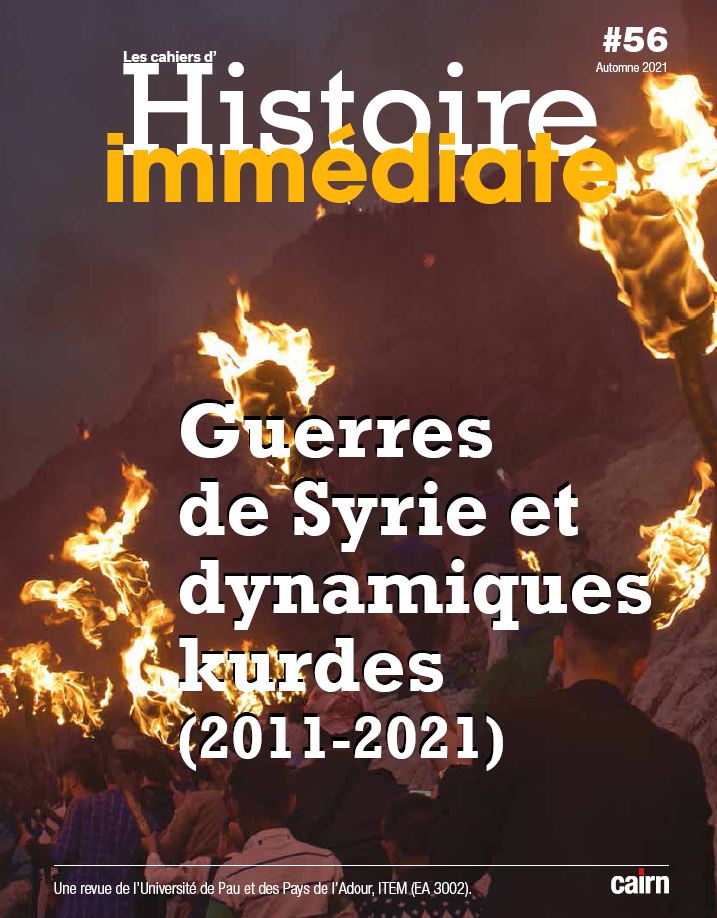
Below is the English translation of the Introduction of the volume “Syrian Wars and Kurdish Dynamics (2011-2021)” (Guerres de Syrie et dynamiques kurdes) I co-edited with Solène Poyraz for the Cahier d’histoire immédiate in 2011. Click here to access all of the contributions of Guerres de Syrie et dynamiques kurdes (2011-2021).
To do something, make a statement, and not give a platform to reductive and nationalist tendencies—that’s what motivated us to conceive of this issue, on the occasion of the 10th anniversary of the revolutions we called “Arab Spring,” but which have affected the world and its societies. As researchers, many assumptions and shortcuts bothered us in the way these processes were analyzed; we therefore had something to say, and we just had to choose an approach. Solène Poyraz, a political scientist working on the effects of the Syrian crisis on Turkey, and Laurent Dissard, an anthropologist specializing in Turkey and the Middle East, chose to address a crucial theme that seems to have changed the game in the Syrian crisis: the Kurds. This is an omnipresent theme, but one often treated through an ethnic and macropolitical lens, which prevents us from grasping the elements of the debate.
From then on, a thorny path of reflection begins, because while the subject may seem to have already been extensively covered from every angle, even over-reported, this dossier shows us that blind spots remain, angles sometimes even deliberately ignored by certain actors on all sides. Over-reporting has even imposed an Orientalist and miserabilist filter, obscuring the realities experienced on the ground, notably through the power of images and a few film initiatives. The contributions of the researchers who responded to the call confirmed the existence of recent ethnographic work offering new perspectives. While this was a question frequently left solely to political science and imbued with fantasies and various projections, this dossier presents, through multidisciplinary approaches and ethnographic practices, a reappropriation of the subject by other social sciences as well as by a new generation of researchers.
Should we speak of war in the singular or the plural, of civil war or of the local expression of a global conflict? These questions made us hesitate
over the wording of the title of this special issue: a laborious and conscientious undertaking, especially given the political but also academic context. The difficulty of addressing recent history, a history in the making and being narrated, also emerged. Hence the need for historical perspectives and the diversity of materials presented in this issue, which was conceived as a response to a history or narrative that imposes itself and clashes with multiple local memories. Beyond the difficulty of presenting an issue on a very recent event, both chronologically and geographically, the co-editors also took on the challenge of renewing a certain approach to the “Kurdish question” or the “Kurdish problem,” an ideologically charged historical construct, preferring the less monolithic and immobilizing term “dynamics.” To do this, nothing is better than moving away from the partisan theories present even in research and refocusing on what makes our profession so rich: fieldwork. It was therefore quite natural that we received numerous proposals of an ethnographic nature, stemming from recent fieldwork. Not that we can do without theory, but the return to the field of younger generations of researchers allows us to rethink concepts in light of social realities and to confront dominant analyses, which are now bordering on anachronism.
Unknown lands, unknown people? To name in order to better rule
The dynamics of the Kurds are unique in that they encompass issues that are both national, specific to the Syrian context, and regional and transnational.
Beyond the weight of ideologies and nationalisms, several temporalities and scales must be clarified to unravel the realities on the ground. This is the entire purpose of this issue. First, it is necessary to recall the historical presence of the Kurds in this region and the self-serving efforts undertaken throughout history to define Kurdistan. According to the famous traveler of the Ottoman Empire, Evliya Çelebi, it stretched from Erzurum (currently in Turkey) to Basra (present-day Iraq). Often referred to as “unknown lands” (diyar-i meçhul), Kurdistan is the object of curiosity and power struggles.
This inevitably leads to attempts to control this population, often criminalized by empires or governments. In Syria, the Kurds are traditionally referred to as eskiya (bandits, smugglers). Historian Stefan Winter explains that the Kurdish tribes of Syria at that time maintained an ambiguous relationship with the Ottoman administration, which distributed titles in exchange for taxes and used them to normalize relations between the state and nomadic society. This power dynamic and control between tribes and politics is also found today in eastern Turkey with the system of village guardians, tasked with acting as mediators (and/or informers) and ensuring social order.
Any attempt at control also implies population displacement, if the population does not consent. This gives rise to demographic engineering practices that are still found today, exacerbated by the ongoing wars in these territories, and which will be addressed in this report. Beyond displacement, Kurdish populations, in the blurring of new forms of conflict that no longer distinguish between combatants and civilians, are also victims of bombings and military operations. In this sense, we must question this relentless drive to delimit a territory and homogenize a group of individuals, thereby limiting their real room for maneuver. What power does this give to the “specialists” and to what extent does it serve the political agenda? Isn’t it also a desire to delimit in order to better control?
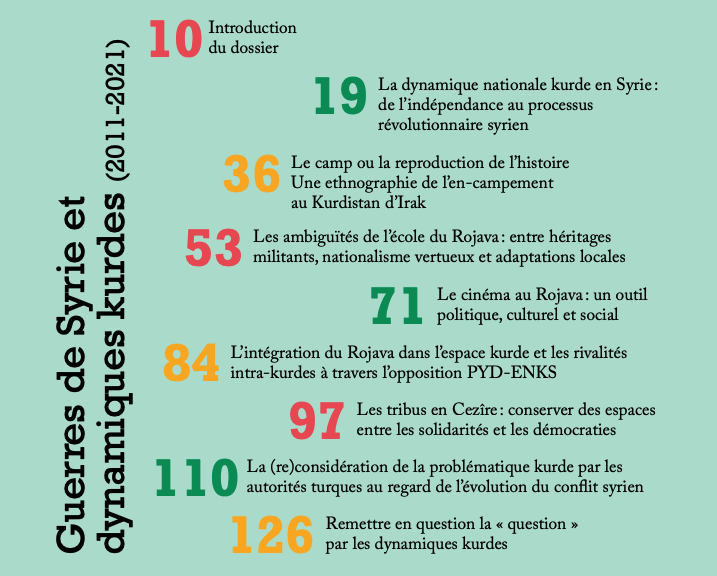
The theme of Kurdish tribes is also found in India Ledenganck’s ethnographic study, which clearly demonstrates that local issues must be addressed beyond the simple “Kurdish question,” given how fluid spaces and relationships have been since 2011. The Meclîsa Rûspî yên Qamîşlî – the Assembly of Elders of Qamîşlî, composed of dignitaries holding “a certain position” within the tribes of the Cezîre region – was presented to the author during her fieldwork in 2019 and 2020 as independent of the AANES (Autonomous Administration of North and East Syria), better known as Rojava. The tribes are involved in social issues, she is told, while the parties, particularly the PYD (Democratic Union Party), are involved in politics. They can influence legal and political decisions, of course, but they are not conceived as political. The tribes maintain values, defend social cohesion, and resolve disputes, particularly those between the AANES and the population, because they are, or at least consider themselves, democratic, unifying, and close to the people. Beyond the ethnic question, it is the constant negotiations between tribes and political bodies that also characterize the social, political, and economic dynamics of northeastern Syria.
Syria: From the periphery to the center in the politicization of the Kurdish question
The genesis of the contemporary Kurdish movement dates back to the late 1970s with the birth of the PKK (Kurdistan Workers’ Party) in 1978, active primarily in eastern Turkey. During the 1990s, which saw the PKK clash with the Turkish state in violent fighting, Syria was relegated to the role of a military base, brilliantly exploited by the Assad regime against Turkey. In 2011, with the outbreak of the Syrian revolution, the Kurdish movement had to take a stand and seize the political and military opportunity that presented itself. The Kurds were then portrayed as leading a revolution parallel to that of the Syrian people, aiming for political and territorial independence, modeled on the Iraqi system. The Kurdish experience known as Rojava, conducted in three “cantons” in northeastern Syria, a region traditionally inhabited by Kurdish populations, began to take shape in 2013. The PYD, the Syrian branch of the PKK, then experimented with forms of autonomy, revealing the foundations of a proto-state.
The outbreak of the Syrian revolution in March 2011 marked a turning point and shook the region and the world, bringing to the forefront issues of territory, borders, and the political forces at play. The “civil war” between regime supporters and opponents was quickly compounded by proxy wars between the powers, hence the plural “wars,” and not Syrian wars, but wars of Syria. This was largely due to the Kurdish dynamics that gradually became involved in the conflict and established themselves as both essential and revealing of the ongoing issues.
A new dynamic emerged from the very beginning of the protest movement in 2011 through the various Kurdish coordination committees, as researcher Joseph Daher reminds us. These predominantly Kurdish organizations faced skepticism from the majority of established Kurdish parties, which remained more or less detached from the Syrian popular uprising. This initial dynamic played a key role in the protest movement but then weakened over time before a new dynamic took hold within the future AANES, led by the PYD and its armed forces in the Rojava cantons. Within this “Syrian” chaos, the Kurds, brought back into focus by the ongoing conflicts, emerged as full-fledged actors, with the Rojava experience as its culmination.
Özcan Yılmaz describes a heterogeneous Kurdish movement rife with tensions that crystallize around the rivalry between the PYD and the ENKS (National Council of Syrian Kurds), which finds its model of autonomy in the Kurdistan Regional Government in Iraq. On one side, the PYD is attempting a new form of local democracy inspired by the writings of the libertarian environmental activist Murray Bookchin, who, through his federalist approach, challenges the idea of a centralizing state. On the other, the ENKS, created in October 2011 to counterbalance the influence of the PYD, advocates for the creation of an autonomous and federal Syrian Kurdistan modeled on Iraqi Kurdistan. The PYD and ENKS are respectively under the tutelage of the PKK in Turkey and the KDP (Kurdistan Democratic Party) in Iraq, which themselves depend on their alliances with regional and international powers. Rojava thus becomes a battleground not only between the PYD and ENKS, but also between the PKK and KDP within their local branches, whose room for maneuver, as Yılmaz reminds us, remains fragile.
As the Kurdish movement organizes itself in northeastern Syria, in connection with southeastern Turkey and also with left-wing parties worldwide, and attempts to forge a winding path between the Free Syrian Army and the regime, the arrival of the Islamic State disrupts regional and international strategies. The Kurdish fighters who find themselves on the front lines against the Islamic State forces are both heroized and abandoned. The Battle of Kobani in 2014 illustrates the positions taken by the states involved in this multifaceted war and constitutes a genuine trauma for the actors on the parties concerned. The Syrian wars have forced the Justice and Development Party (President Recep Tayyip Erdoğan’s AKP) in Turkey to reposition itself. The announcement by the PYD of the autonomy of Rojava in November 2013 worries the Turkish authorities who see it as a base of support and fallback position for the PKK.
The year 2015 thus marked a turning point, according to political scientist Aurélien Denizeau. The AKP ended the peace process, returning to the military and security angle. It sent Turkish armed forces into northern Syria starting in 2016 and created an alliance with the MHP, the far-right Nationalist Action Party, starting in 2017. It is therefore the entire Turkish political landscape, adds Denizeau, which, based on these new Kurdish dynamics in Syria, is forced to reposition itself ideologically and strategically. For Turkey, the anti-Kurdish obsession has taken precedence over support for the Syrian opposition: this is followed by military operations in northeastern Syria to create a “buffer zone,” a reception area for “refugees” which is in fact changing the demographic composition of the region. Inside, as we write these lines, the “Kobanê trial” is underway against members of the pro-Kurdish party, the HDP or Peoples’ Democratic Party, for supporting terrorism. After a decade in Syria, will Turkey once again become the center of Kurdish politicization?
The damage caused by homogenization: a multi-faceted approach to describing a plural identity.
To avoid falling into the counterproductive illusion of a unified and monolithic group, we prefer to speak of Kurdish spaces. For we are dealing with a plurality of physical and cultural affiliations that transcend the logic of borders and territories and materialize in neighborhoods, cities, regions, or even in camps (Charlotte Watelet), war zones, and even in collective memory, historical imagination (Boris James), or cinematic culture (Lucile Irigoyen).
In this issue, anthropologist Charlotte Watelet offers an ethnography of the camps where this power dynamic between the PYD and the KDP is evident. Her fieldwork, conducted from 2014 onwards, takes us to the so-called temporary camps in the autonomous Kurdistan Region of Iraq, administered by the KDP, and in particular the Qushtapa camp, which hosts more than 8,000 Kurdish asylum seekers, most of whom come from the AANES, managed by the PYD. Watelet then examines the effect of humanitarian aid, which reproduces existing borders. The humanitarian solution proposed by the United Nations Refugee Agency (UNHCR) with other local humanitarian organizations leads to a retreat of both Kurdish communities. While humanitarian actors reproduce the territorial, material, and symbolic class boundary between Syrian Kurds and Iraqi Kurds, the camps themselves serve to keep at a distance Syrian refugees who may be close to the PYD in Iraqi territory controlled by the KDP. This situation of encampment, Watelet explains, affects not only Kurdish identity but also a subjective relationship to history.
For his part, historian Boris James reveals the inner workings of the construction of the nationalist and nationalizing narrative, with a study of school textbooks in Rojava, a testing ground for the PKK/PYD. According to them, this is the logical continuation of their emancipation project, which involves armed struggle but also the education of the masses. The history books distributed in Rojava schools from 2016 onwards clearly have a political as well as an educational content. Originating from a PKK framework (nationalist, revolutionary, pro-Kurdish), their content refers to all Kurdish and international revolutions, but presents Abdullah Öcalan, founder and leader of the PKK, as the guide who will lead all of humanity to freedom. In the local context of Rojava, the nationalist discourse of the PKK/PYD is even presented as transcending Kurdish nationalism, hence one of the ambiguities in school textbooks, according to James.
Another localized form of expression of Kurdishness is addressed by Lucile Irigoyen. Because beyond schools, the PYD is also seeking international visibility. In her article, Lucile Irigoyen sheds light on the diversity of social, political, and cultural dynamics and on the political use of cinema in Rojava, through the example of the Komina Film a Rojava. The approach of this Film Commune of Rojava, composed of Syrian Kurds seeking forms of artistic expression, PKK members from Turkey, and foreign artists and professionals with a political awareness of images, consists of filming, producing, and distributing films, as well as teaching cinema by organizing theoretical and practical training. Cinema allows the PYD to extend its influence, develop strategies for political demands, and simultaneously undertake a cultural reconquest of the historical narrative. Its objectives are to visually depict the (re)constitution of a Kurdish community in northeastern Syria in order to give a voice back to the inhabitants of the region, to make them actors in their own narratives and representations, and to move them beyond their solely victimized status internationally while using cinema as a tool for both individual and collective reconstruction.
These are all spaces in which a pluralistic Kurdish identity and intra-Kurdish power dynamics are expressed. It is by analyzing this plurality and the multiple dynamics at play that we can move beyond the “Kurdish question” and get closer to the lived and felt social realities. This is made possible by this specifically Syrian moment, an opportune moment that highlights the ongoing dynamics and served as the starting point for the reflections begun in this issue. The events in Syria presented a specific conjuncture of crisis that allows us, as researchers, to identify elements of continuity or rupture in the ongoing processes. This moment of crisis, which re-examines traditional analytical frameworks, authorizes and encourages research to explore new approaches that, as Jean-François Pérouse writes in the conclusion of this issue, allow us to question the very “question.”
English translation of the Introduction to the volume “Syrian Wars and Kurdish Dynamics (2011-2021)” (Guerres de Syrie et dynamiques kurdes) I co-edited with Solène Poyraz for the Cahier d’histoire immédiate in 2011. Click here to access all of the contributions of Guerres de Syrie et dynamiques kurdes (2011-2021).


You must be logged in to post a comment.