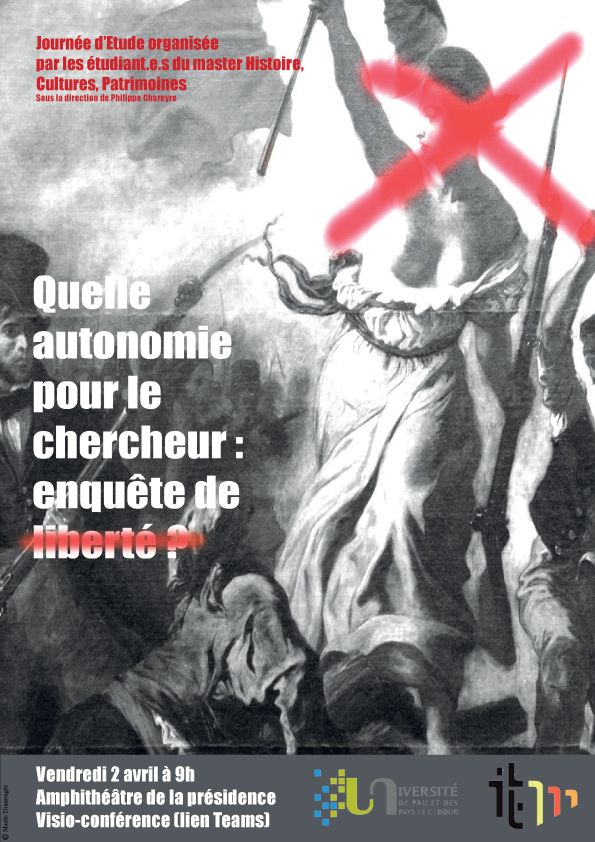
At a time when universities across Europe and beyond are confronting renewed pressures — from funding regimes and performance metrics to political scrutiny — the question of academic freedom has regained urgency. What does it mean, today, for a researcher to act autonomously? These questions were at the heart of the one-day workshop « Quelle autonomie pour le chercheur : enquête de liberté ?», held at the Université de Pau et des Pays de l’Adour on April 2nd, 2021.
The morning session brought together Anouk Bertaux, Caroline Le Mao, and Laurent Jolly in a sustained reflection on the conditions under which historians exercise autonomy. Bertaux opened with an analysis of the historian’s encounter with “pasts that do not pass,” emphasizing how scholarly freedom is tested when the archive remains politically and emotionally charged. Le Mao’s examination of the slave trade in Nouvelle-Aquitaine further demonstrated that autonomy entails responsibility: confronting difficult regional legacies requires methodological rigor and ethical clarity. Jolly, drawing on colonial and postcolonial contexts in the Horn of Africa, addressed censorship and self-censorship, underscoring that autonomy is shaped not only by external constraints but also by the internal limits researchers may impose on themselves.

Autonomy in Practice
The afternoon session extended these questions through contributions by Mathilde Lamothe, Laurent Jalabert, and Philippe Pujo. Lamothe explored the ethical dilemmas of fieldwork, particularly the tension between confidentiality and dissemination, showing how autonomy is structured — rather than curtailed — by ethical commitments. Jalabert examined the historian’s posture in relation to contemporary sources, while Pujo reflected on the complexities that arise when scholarly and creative practices intersect. Together, their interventions highlighted the situated and relational character of autonomy, shaped by proximity to sources, institutional frameworks, and disciplinary expectations.
In my concluding remarks, I proposed that researcher autonomy be understood less as independence from constraint than as a continuous practice of negotiation. Across the day’s discussions, autonomy emerged as something enacted in concrete scholarly choices — what questions to pursue, what silences to confront, and what responsibilities to assume. If current debates often emphasize formal protections and external threats, this workshop underscored that academic freedom is also exercised at the micro-level of research itself: in reflexive method, ethical discernment, and the disciplined practice of inquiry.


You must be logged in to post a comment.