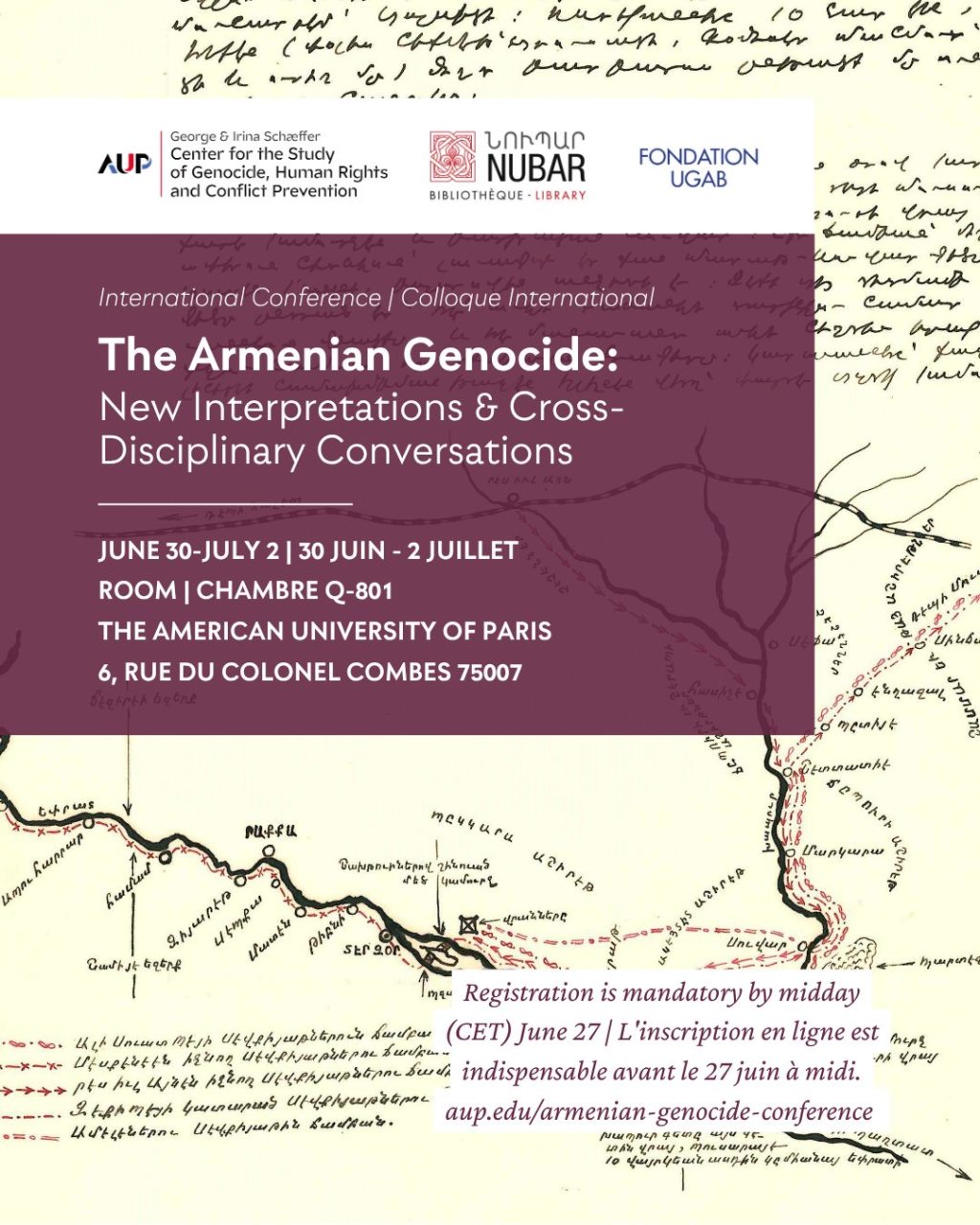
Held at the American University of Paris from June 30 to July 2, 2025, The Armenian Genocide: New Interpretations & Cross-Disciplinary Conversations captured a clear shift in the field. Rather than returning to questions of proof or chronology, many contributions focused on what follows genocide: its social, material, and epistemic afterlives, and the ways violence continues to shape memory, knowledge, and space long after the event itself.
Across panels bringing together history, anthropology, heritage studies, literature, and visual culture, genocide emerged not as a closed past but as an ongoing condition sustained through archives, institutions, landscapes, and interpretive regimes that both reveal and obscure its effects. Discussions of testimony, representation, perpetrators’ careers, and cultural practices repeatedly returned to the problem of how violence persists through expertise and governance.

These concerns came into sharp focus during the panel Post-Genocide Victim Erasure and Appropriation, which examined how violence endures through processes that marginalize victims while redistributing land, culture, and legitimacy. Contributions addressed settler colonialism and racial capitalism (Alice von Bieberstein), denativization and the afterlives of genocide in Turkey (Hakem Al-Rustom), and the epistemic labor of learned denial (Emmanuel Szurek). Taken together, the panel approached erasure not as absence, but as an active, ongoing process embedded in post-genocidal governance.
My own contribution, drawing on work in Eastern Turkey, approached heritage witnessing as a post-genocidal practice shaped as much by disappearance as by preservation, where acts of documentation and care unfold within landscapes already structured by loss. In dialogue with work on post-genocide cultural recovery and remembrance by Heghnar Zeitlian Watenpaugh and Vahé Tachjian, the discussion highlighted how heritage can function simultaneously as recognition, displacement, and appropriation.
Warm thanks are due to Boris Adjemian and the organizers at AUP for convening such a rigorous set of conversations, as well as to Hakan Seckinelgin for his incisive role as discussant. What emerged was not a single new interpretation, but a shared insistence on thinking genocide beyond the event—through its afterlives, its infrastructures, and its silences.


You must be logged in to post a comment.