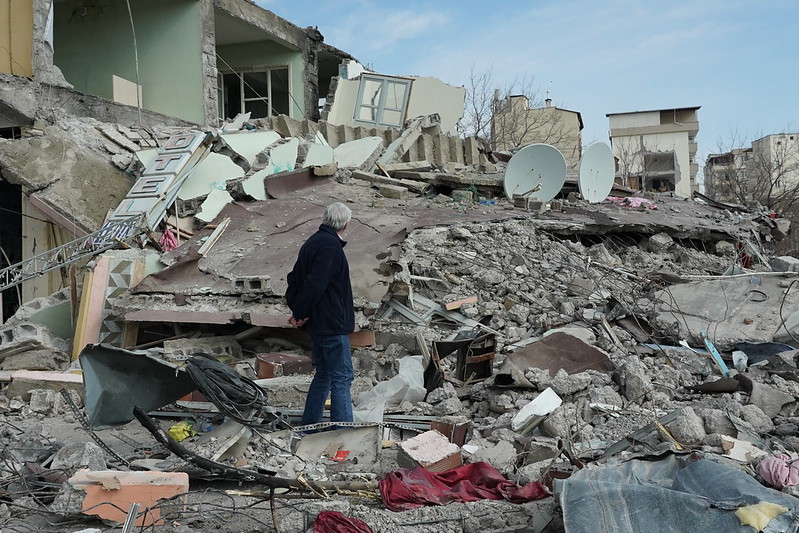
On 06/02/23, two earthquakes hit Eastern Turkey with devastating effects. More than 160,000 buildings collapsed or were severely damaged, around 1,5 million people were left homeless, and more than 50,000 deaths were reported. We heard how 06/02 was the strongest in the region since the 1939 Erzincan earthquake. Some of us might remember Bingöl in 1971, Lice in 1975, Muradiye in 1976, Erzurum in 1983, Erzincan in 1992, Bingöl in 2003, Elazığ in 2010, Van in 2011, Elazığ in 2020. In Yalova, an Earthquake Monument (Yalova Deprem Anıtı) was inaugurated a year after the 1999 İzmit earthquake. It is made up of marble blocks with the names of 3,000 victims and a tiny hole next to each name to hold a flower. In Sakarya, the Earthquake Culture Museum (Deprem Kültür Müzesi) is designed to look as if it was damaged by an earthquake. Similarly, the irregular concrete walls of the November 12th Earthquake Memorial and Museum (12 Kasım Deprem Anıtı ve Müzesi) in Bolu was designed by YNRDG Architecture to remind people of the city’s past destruction.
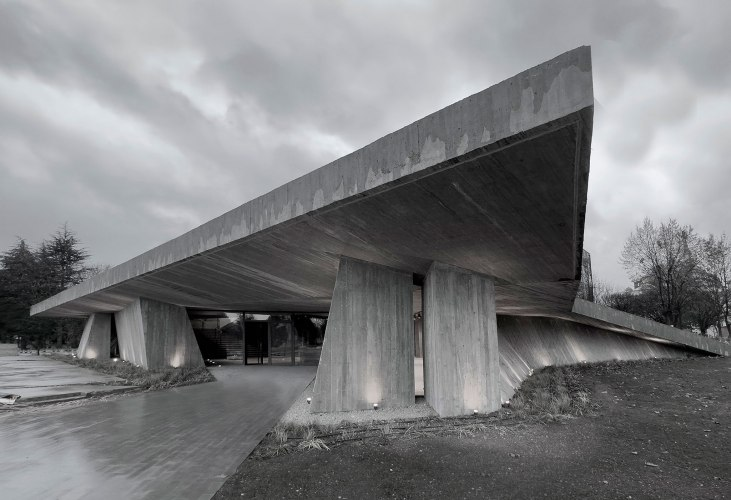
We commemorate earthquakes in museums, yet the necessary precautions were not taken to prevent the disastrous consequences of 06/02. There was nothing natural about the tragedy. It was not the earthquake that killed people, but the buildings. Here, we need to consider the policies taken by successive governments since the 1980s, which led to quick urban expansion of agricultural zones and squatter areas outside city centers into an uncontrolled suburbanization neither sustainable nor safe. These new residential areas have been filled with high-rise buildings, mostly four-five story buildings erected quickly by small contractors. These low-quality structures built without features providing them enough stability were not earthquake-resistant. Moreover, very little retrofitting has been done on existing buildings.
After the 1999 İzmit earthquake, more stringent safety standards regarding earthquake prevention were introduced. These new construction regulations and norms concerning earthquake resilience required contractors to use high-quality concrete reinforced with steel bars as well as columns and beams distributed to effectively absorb an earthquake’s impact. Turkey’s revised “Building Code” was not always followed however. Inspection was led by the private sector, which lacked the required objectivity. In addition, construction amnesties have been provided by the government, that is payments made by construction firms in order to bypass a building’s safety certification. Across the area affected by 06/02, approximately 75,000 buildings benefitted from these. Moreover, the earthquake tax established in 1999 to retrofit buildings was spent on building new infrastructures instead.
There was a lack of preparedness for a predictable event and the government failed to respond efficiently. Testimonies emerged of relief trucks not allowed to reach their destination. Some (pro-government) areas and cities were favored over others and private undertakings to remove rubbles not allowed. The blame was put on AFAD (Turkey’s Disaster and Emergency Management Authority) filled with government cronies like İsmail Palakoğlu, a theologian with no experience in disaster management. AFAD sidelined NGOs, civil society and citizen-led initiatives, and the decision to not mobilize the Army was also criticized. We think of 06/02 as sudden, dramatic, destructive, and sensational, but the disaster was the result of political decisions taken over the last 50 years that did not consider seriously enough a possible tragedy. The uncontrolled urban expansion, the construction of non-earthquake resistant buildings, the lack of enforcement of new regulations, construction amnesties and earthquake taxes, and the lack of preparedness in the government’s response led thousands of people into thinking they were buying homes (sometimes “luxurious” apartments like Antakya’s Rönesans Rezidans), when in fact they were buying their own coffins.
Newspapers called 06/02 a story of corporate and political greed. One of the largest sectors in Turkey’s economy is the construction sector, a result of World Bank and IMF directives reinforcing it at the detriment of others, and leading large construction groups (“gang of five”) being granted tax incentives. What 06/02 also revealed was the line drawn between pro-Erdoğan, whose faith in their leader was not shaken (i.e. the AKP government did all it could, Erdoğan came as as fast as he could, AFAD was prepared to carry out the necessary interventions). Meanwhile, critiques of Erdoğan tried to prove them wrong (i.e. a disaster of this scale could have been prevented, thousands of lives could have been saved, neither government nor AFAD was competent). It was also thought that the earthquake would cause Erdoğan’s defeat in the upcoming May 2023 elections. Here, the critics were wrong.
What 06/02 foregrounded was a class divide between rich and poor, powerful and powerless, perpetrators and victims. It reminded us how ‘heritage’ is often produced out of disasters (e.g. the idea of an earthquake museum in Antep has already been launched). Commemorating also means ‘forgetting’ enough to bring back to memory collectively. Here, I explore other ways to think about ‘earthquake as heritage’ beyond the region’s history of earthquakes, that is both the negative and positive of ‘earthquake heritage,’ the manner in which earthquake victims are memorialized or museumified, the way earthquakes become part of our individual and collective memory, the links between ‘heritage of urbanism’ and earthquake disasters, the immediate aftermath of earthquake heritage (e.g. how to manage earthquake debris; the ‘slow violence’ of earthquake disasters and their disposable people and unimagined communities (Robert Nixon), the links between earthquakes and a country’s heritage of corruption and nepotism, and earthquake diplomacy as uniting but also potentially divisive. Finally, I ask whether we can transform this negative ‘earthquake heritage’ into something constructive for the future?
This is a short summary of a presentation I gave at the Archaeological Institute of America (AIA) 2024 annual conference in the Colloquium ‘Ecologies of Cultural Heritage in Turkey: Practice, Preservation, and the Future’ sponsored by the AIA Cultural Heritage Committee and AIA Anatolian Archaeology Interest Group. Many thanks to Ömür Harmanşah and Alexander Bauer for organising this panel, to Zeynep Boz from the Ministry of Culture and Tourism for her discussion afterwards, and to Sevil Tırpan, Evrim Ulusan, Işılay Gürsu, and Gül Pulhan for their participation.


You must be logged in to post a comment.