I first visited Harput in the early 2000s while researching the nearby Keban Dam and its archaeological rescue project. Returning over the years, I encountered successive changes to the town’s built environment: restored streets, renovated buildings, new museums and an expanding religious training complex. These observations form part of my forthcoming article, “Making Harput into Elazığ’s Past”.
Harput can seem remarkably quiet, particularly around the Sarahatun Mosque. Its rhythms change with the arrival of visitors. The town remains inhabited by a small resident population, but much of the activity I encountered depended on people arriving from elsewhere, staying for a few hours and returning to Elazığ. Restaurants filled for evening meals, especially during Ramazan. Families drove up for weekend picnics, while friends drank beer behind parked cars, away from their more conservative neighbourhoods.
Old photographs made this relatively empty landscape difficult to reconcile with the busy town it had once been. The castle and leaning minaret remained recognisable, but houses, shops and schools that once crowded around them had given way to scattered ruins and open ground. Walking through Harput sharpened that contrast. Its cemeteries seemed disproportionate to the small resident population, as if the dead outnumbered the living. The gaps raised questions that a visit alone could not answer.
Institutions now occupy parts of this landscape. The large Harput Dini İhtisas Merkezi, or Harput Centre for Specialised Religious Training, trains religious personnel under the Diyanet Academy. Its scale makes the state’s religious authority conspicuous among the town’s surviving monuments. Alongside the historic mosques, it presents Harput’s Islamic past as a continuing source of authority and belonging.
Near the Ulu Camii, the Şefik Gül Culture House offers a different encounter with inheritance. The nineteenth-century mansion, restored and opened as a house museum in 2005, contains furnished rooms, household objects and a garden. It supplies an image of inhabited Harput that the surrounding gaps no longer provide. Yet calling these objects “Harput culture” can imply a shared inheritance without identifying the different communities whose lives produced it.
Near the castle, the Harput Music Museum, opened in 2022, displays instruments, recordings, photographs and wax figures depicting kürsübaşı, a winter gathering around a heated low table for conversation and music. Live performances also take place there. Preservation sustains a living practice, but it raises questions about attribution: whose contributions are remembered, and how are the relationships through which the repertory circulated represented?
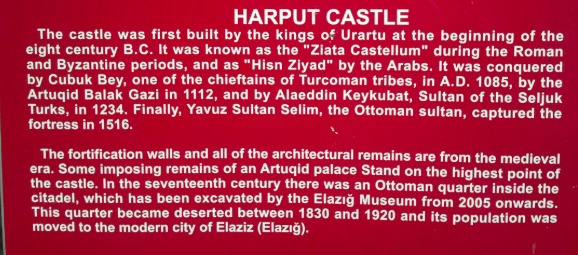
Below the castle, the Syriac Church of the Virgin Mary remains an identifiable landmark. Armenian church sites are much harder to read. Surviving fragments need names and historical context before they become intelligible as parts of former neighbourhoods. The sign at the castle entrance, meanwhile, describes the departure of an Ottoman quarter’s inhabitants as a move to the city below. Its dates encompass massacres and genocide, but the account does not name them.
The changes I encountered made more of Harput available to visitors. They did not necessarily explain how its houses, institutions and neighbourhoods had been lost, or how their remains came to be inherited. My earlier fieldnotes from Arapgir ask related questions. In Harput, walking between restored buildings and open ground brings me back to the people and relationships that once sustained the town.


You must be logged in to post a comment.