The 2016 discovery of a 4,000-year-old siege relief near Harput and its journey to the Elazığ Kent Museum
The metal bucket struck stone with a dull, unexpected sound.
İshak Yurter, an excavator operator working on a municipal tree-planting project, stopped his machine and leaned out of the cab. The work that morning in the Nevruz Forest below Harput had been routine—clearing brush, digging shallow pits, planting saplings on the slopes beneath the old citadel that rises above the modern city of Elazığ in Eastern Turkey. But the soil that fell away from the shovel revealed something unusual: a flat surface where none should have been. As Yurter pushed aside more earth, faint lines began to appear—first a groove, then the outline of a carved figure emerging from the ground.
This was no ordinary stone.
Work stopped immediately. Local authorities were notified, and within hours specialists from the Elazığ Archaeology and Ethnography Museum arrived at the site. What Yurter had uncovered on that May morning in 2016 was not a stray block of masonry but the fragments of a monumental relief more than four thousand years old.
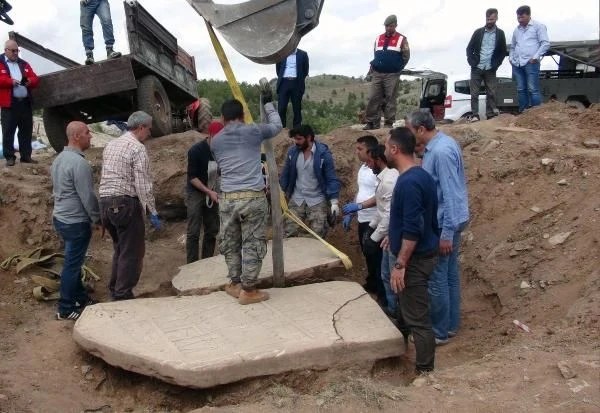
When the stone was fully exposed, it turned out to consist of several large pieces that could be reassembled into a single composition. The fragments were lifted from the ground and transported down the hill toward the museum in Elazığ. Like many archaeological discoveries in the region, the relief quickly entered a familiar institutional pathway: documentation, conservation, restoration. For a brief moment it appeared in the galleries of the Elazığ Archaeology and Ethnography Museum.
Then the museum itself closed.
Since 2016 the building has been shut to the public, and many of its collections—including the Harput relief—have been transferred elsewhere in the city. Today the reconstructed monument is displayed in the Elazığ Kent Müzesi, the town museum housed in a former government building near the center of the city.
Yet the object itself remains extraordinary.
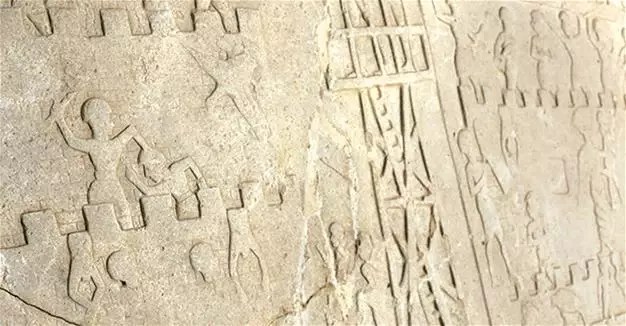
When conservators completed the reconstruction, the relief revealed a massive sandstone slab nearly three meters across. Its surface is organized into a sequence of scenes carved in low relief. Together they form a narrative of siege and conquest. A fortified city rises on one side of the composition, its defenders crowding the walls. Attackers advance with ladders and a wheeled siege tower, climbing the ramparts as projectiles fly between the two sides. Elsewhere prisoners are bound and led away. Figures carry spoils from the captured settlement. Beneath the chaos of battle, bodies lie scattered on the ground.
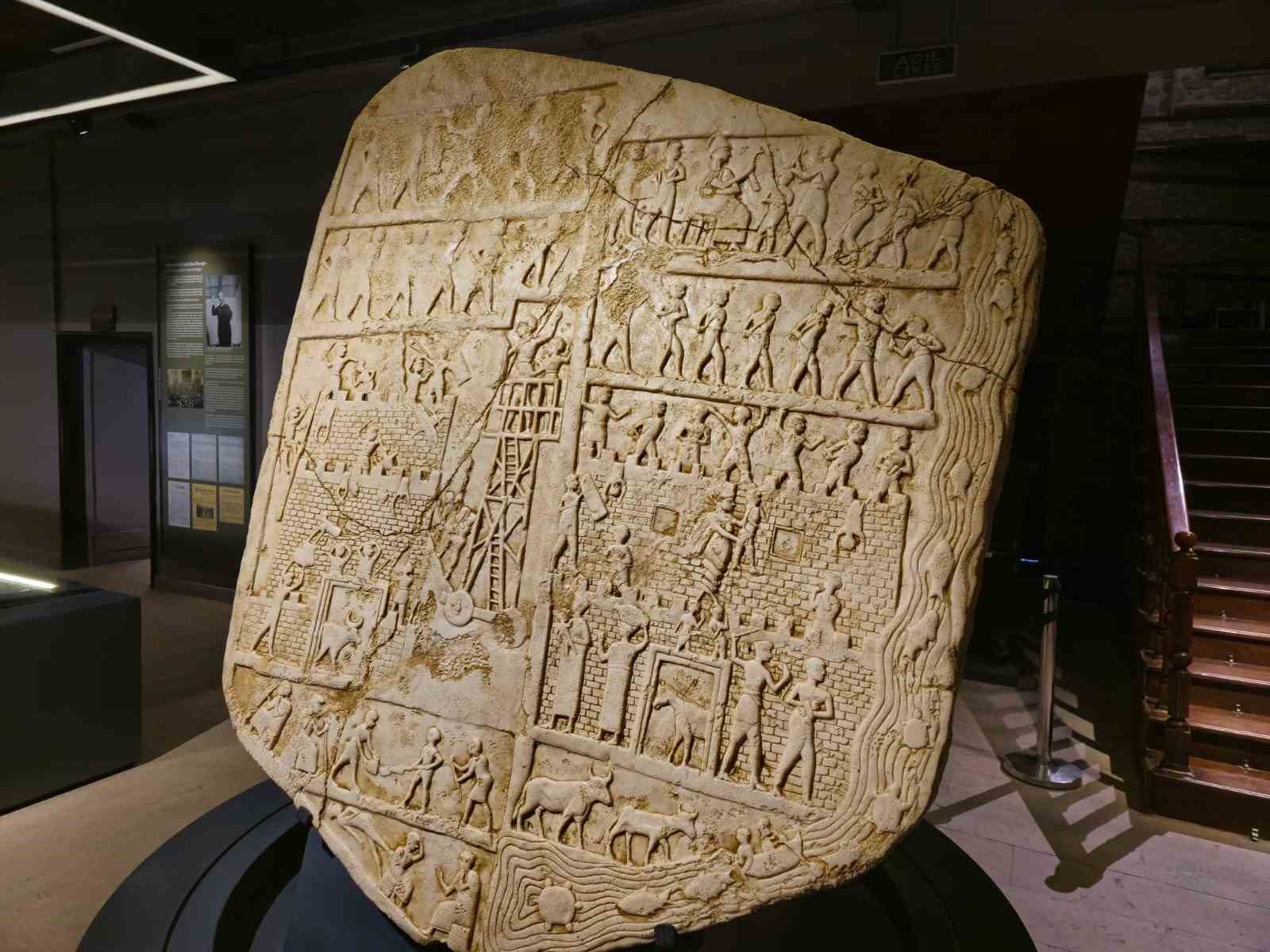
Across the composition runs a river rendered with surprising detail—fish and turtles swimming beneath the carved waves. Above the conflict appears a supernatural presence: a winged figure with a serpentine body, hovering over the scene as if sanctioning the victory.
The monument likely commemorates the capture of a fortified settlement somewhere in the Euphrates Valley nearly four thousand years ago. Scholars have noted its striking parallels with the long tradition of Near Eastern victory monuments, where rulers recorded military triumphs through carved narratives in stone. The Harput relief is unusual, however, for the complexity of its scenes and the vivid depiction of siege warfare. Archaeologists have compared its imagery both to earlier Mesopotamian steles and to later Assyrian palace reliefs, suggesting that the monument occupies an important place in the long history of narrative art in the ancient Near East.
Excavations carried out near the discovery site revealed traces of a settlement beneath the forest soil. The remains belong to a fortified habitation destroyed by fire sometime in the early second millennium BCE. Pottery and other finds indicate that the site was already part of a network of communities connected to the wider political and commercial worlds of northern Mesopotamia and Anatolia. The relief may once have stood within this settlement or nearby, commemorating a military victory that reshaped the region’s landscape of power.
The discovery also altered modern understandings of Harput’s past. Long associated primarily with medieval and Urartian remains, the area had rarely produced evidence for such an early monumental tradition. The relief pushed the documented history of the region back roughly a millennium, revealing that complex political events were unfolding here centuries earlier than previously assumed.
In one sense, the story of the Harput relief is exceptional. In another, it is surprisingly typical. Across the Upper Euphrates valley, archaeological discoveries often begin not with carefully planned excavations but with ordinary work: farmers turning the soil, construction crews digging foundations, forestry teams clearing land. Beneath fields, villages, and hillsides lie traces of earlier worlds that surface unexpectedly when the ground is disturbed.
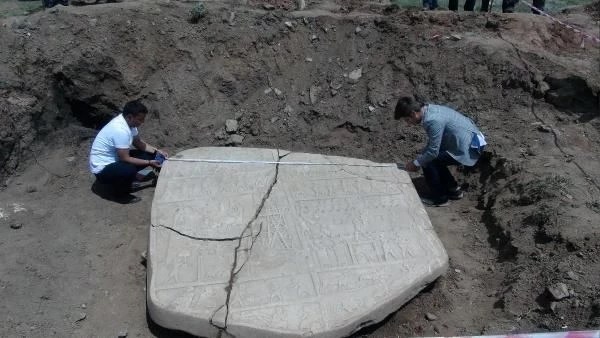
The Harput relief followed this familiar path. For thousands of years it lay buried beneath the soil of a forested hillside. Then, in a brief moment of chance, the past surfaced again: a shovel struck stone, carved lines appeared in the earth, and a forgotten monument returned to view.
Today the relief stands in the Elazığ Kent Müzesi, far from the slope where it was discovered. Visitors encounter it not in the landscape that once gave it meaning but within the orderly spaces of a museum gallery. The movement from hillside to institution has become routine in archaeology. Objects travel; landscapes remain where they are.
Museums, however, also shape how works of art become known to the world. Some monuments—displayed in institutions in Paris, Berlin, or London—become celebrated “masterpieces” of world civilization. Others remain largely unknown, even when they are equally striking and historically revealing. The Harput relief belongs to this second category. Discovered by chance and preserved in a provincial museum, it has not yet entered the global canon.
Yet the stone itself tells a story as dramatic as any celebrated monument: a battle carved in sandstone four thousand years ago, waiting beneath the soil until an ordinary act of digging brought it back into the light.
Archaeology in Context
Two recent studies have examined the Harput relief in detail. Archaeologists Eşref Abay, Bülent Demir, and Veli Sevin have emphasized the monument’s importance as one of the most elaborate visual narratives of warfare from ancient Anatolia, highlighting its depiction of siege machinery, captives, and divine intervention. Roberto Dan and Andrea Cesaretti have explored its broader artistic context, suggesting that the relief may belong to a regional tradition linking eastern Anatolia to the wider artistic networks of Mesopotamia and the Levant. Together these studies show how a discovery made during routine forestry work opened an unexpected window onto the early history of the Upper Euphrates valley.


You must be logged in to post a comment.